
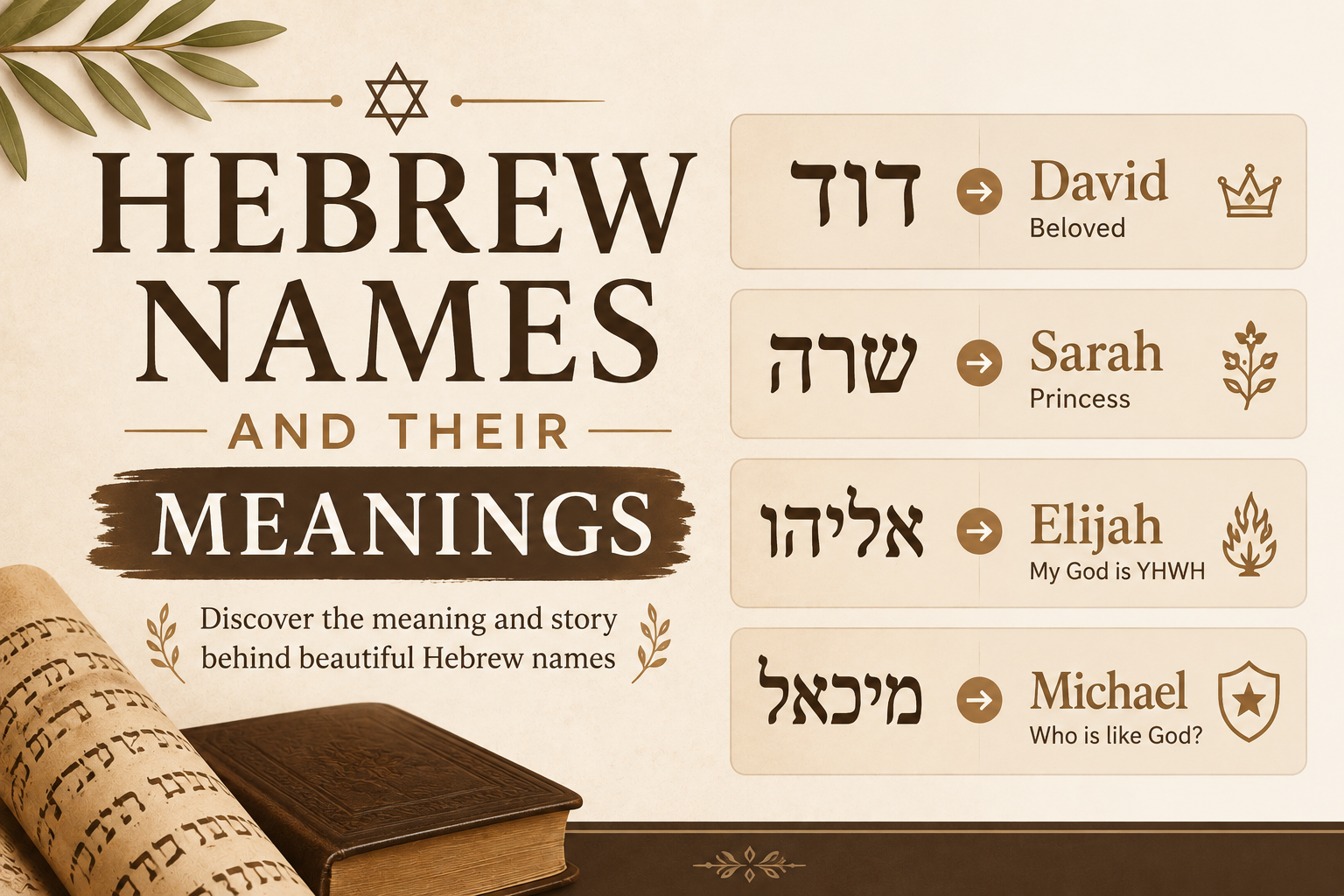
Hebrew names aren't just labels — they're miniature poems. Unlike English names, which often arrive in the language as opaque sound-clusters inherited from other cultures (what does "Edward" literally mean to a modern English speaker?), almost every Hebrew name is built from transparent, meaningful roots that any Hebrew speaker can decode in real time. דָּוִד (David) visibly contains the word דּוֹד (beloved). אֲבִיגַיִל (Avigail / Abigail) is literally "my father's joy." אֲרִיאֵל (Ariel) is "lion of God" — and you can see both the "lion" (אֲרִי) and the "God" (אֵל) sitting inside it.
This guide collects the most popular Hebrew boy and girl names in use today — both the Biblical classics that have been given for thousands of years and the modern Israeli names that reflect a younger, nature-connected Hebrew-speaking culture. For every name you'll get the Hebrew spelling, a pronunciation guide, and the literal meaning broken down to its root.
Why Hebrew Names Are Different
In most languages, a name is an atomic unit — you don't parse "Margaret" into component parts when you hear it. But Hebrew names are overwhelmingly composite: they're built by combining words, roots, and theophoric elements (pieces that reference God) into a single name that reads as a complete phrase.
The most common building blocks you'll see over and over:
| Element | Hebrew | Meaning | Appears In |
|---|---|---|---|
| El | אֵל | God | Daniel, Ariel, Gabriel, Michael, Raphael, Yisrael |
| Yah / Yahu | יָהּ / יָהוּ | God (shortened form of YHVH) | Eliyahu, Yirmiyahu, Netanyah, Ovadyah |
| Yeho- | יְהוֹ | God (prefix form of YHVH) | Yehonatan, Yehoshua, Yehoyada |
| Natán | נָתַן | He gave | Natan, Netanel, Yehonatan, Elnatan |
| Or | אוֹר | Light | Or, Ori, Orli, Lior, Maor |
| Li | לִי | To me / My (suffix) | Ori, Lior, Orli, Kochavi, Shiri |
| Chai | חַי | Alive / Life | Chaim, Chaya, Chai |
| Shalom | שָׁלוֹם | Peace | Shlomo, Avshalom, Shalom |
Once you internalize these building blocks, Hebrew names stop feeling like arbitrary sounds and start reading like the miniature sentences they are. נְתַנְאֵל (Netanel) = "God gave." אוֹרְלִי (Orli) = "light for me." מִיכָאֵל (Michael) = "who is like God?" — a rhetorical question turned into a name.
Popular Hebrew Boy Names
What follows are the Hebrew boy names you'll encounter most often in Israel today — a mix of Biblical heavyweights, nature names that surged in the last few decades, and short, punchy modern favorites.
| Hebrew | Transliteration | Pronunciation | Meaning |
|---|---|---|---|
| דָּוִד | David | dah-VEED | Beloved — from the root ד.ו.ד (d-w-d), related to affection |
| אֲרִיאֵל | Ariel | ah-ree-EL | Lion of God — אֲרִי (ari, "lion") + אֵל (el, "God") |
| נֹעַם | Noam | NOH-ahm | Pleasantness, sweetness — from the root נ.ע.מ |
| יוֹנָתָן | Yonatan | yoh-nah-TAHN | God has given — יְהוֹ (Yeho, a form of God's name) + נָתַן (natan, "gave") |
| אִיתַי | Itai | ee-TAI | With me — directly from the Biblical Hebrew word for "there is with me" |
| דָּנִיֵּאל | Daniel | dah-nee-EL | God is my judge — דָּן (dan, "judged") + אֵל (el, "God") |
| אֵיתָן | Eitan | ey-TAHN | Strong, enduring, steady — describing something firmly rooted |
| אוּרִי | Uri | OO-ree | My light — אוּר (or, "light") + י (i, "my") |
| אָדָם | Adam | ah-DAHM | Man, human being — also tied to אֲדָמָה (adamah, "earth, ground") |
| מֹשֶׁה | Moshe | moh-SHEH | Drawn from the water — from the root מ.ש.ה (m-sh-h, "to draw out") |
| גַּבְרִיאֵל | Gabriel | gahv-ree-EL | God is my strength — גֶּבֶר (gever, "man/hero") + אֵל (el, "God") |
| רָפָאֵל | Raphael | rah-fah-EL | God heals — רָפָא (rafa, "healed") + אֵל (el, "God") |
| מִיכָאֵל | Michael | mee-khah-EL | Who is like God? — a rhetorical question: מִי (mi, "who") + כָּ (ka, "like") + אֵל (el, "God") |
| אַבְרָהָם | Avraham | ahv-rah-HAHM | Father of many — from אַב (av, "father") + הֲמוֹן (hamon, "multitude") |
| יִצְחָק | Yitzhak | yeets-KHAHK | He will laugh — from the root צ.ח.ק (ts-ch-k, "to laugh") |
| יַעֲקֹב | Yaakov | yah-ah-KOV | He who follows / held by the heel — from עָקֵב (akev, "heel") |
| לֵוִי | Levi | leh-VEE | Joined, attached — from the root ל.ו.ה (l-w-h, "to accompany") |
| שְׁמוּאֵל | Shmuel | shmoo-EL | God has heard — or "his name is God" — שֵׁם (shem, "name") + אֵל (el, "God") |
| עִמָּנוּאֵל | Immanuel | ee-mah-noo-EL | God is with us — עִמָּנוּ (imanu, "with us") + אֵל (el, "God") |
| נָתָן | Natan | nah-TAHN | He gave — from the root נ.ת.נ (n-t-n, "to give") |
| אֲשֵׁר | Asher | ah-SHEHR | Happy, blessed, fortunate — from the root א.ש.ר (a-sh-r, "happiness") |
| בֹּעַז | Boaz | BOH-ahz | In him is strength — בֹּ (bo, "in him") + עֹז (oz, "strength") |
Several of these names — David, Daniel, Michael, Gabriel, Raphael, Adam — have traveled far beyond Hebrew and become staples of naming traditions across dozens of languages. But the Hebrew originals carry layers of meaning that the borrowed versions leave behind. When an Israeli hears אֲרִיאֵל, they don't hear a random pleasant sound — they hear "lion of God."
Popular Hebrew Girl Names
Hebrew girl names draw from the same well — the Bible, nature, and abstract virtues — but have their own distinct flavor. Many of the most popular Israeli girl names today are nature words (טַל, Tal, "dew"; שִׁירָה, Shira, "song"; תָּמָר, Tamar, "date palm"), and several of the top names are unisex.
| Hebrew | Transliteration | Pronunciation | Meaning |
|---|---|---|---|
| שָׂרָה | Sarah | sah-RAH | Princess — from the root ש.ר.ר (s-r-r, "to rule") |
| נוֹעָה | Noa | NOH-ah | Movement, motion — from the root נ.ו.ע (n-w-a, "to move") |
| תָּמָר | Tamar | tah-MAHR | Date palm tree — a symbol of beauty, fruitfulness, and uprightness |
| יָעֵל | Yael | yah-EL | Mountain goat, ibex — a name from the Book of Judges; graceful and strong |
| מַיָּה | Maya | MAI-yah | Water — related to מַיִם (mayim, "water"); also a goddess name in other cultures, but the Hebrew root is independent |
| אֲבִיגַיִל | Avigail | ah-vee-GAH-yil | Father's joy — אָב (av, "father") + גִּיל (gil, "joy") |
| שִׁירָה | Shira | shee-RAH | Song, poetry — from the root ש.י.ר (sh-y-r, "to sing") |
| מִיכַל | Michal | mee-KHAHL | Who is like God? — the feminine form of Michael; also means "brook, stream" |
| טַלְיָה | Talia | tahl-YAH | Dew from God — טַל (tal, "dew") + יָהּ (Yah, "God") |
| רִבְקָה | Rivka | reev-KAH | To tie, to bind — from the root ר.ב.ק (r-b-k); the Biblical Rebecca |
| רָחֵל | Rachel | rah-KHEL | Ewe (female sheep) — a pastoral image of gentleness and value |
| לֵאָה | Leah | leh-AH | Weary, tired — but also possibly "wild cow" in an older Semitic layer; one of the matriarchs |
| עֲדִי | Adi | ah-DEE | Jewel, ornament — from the root ע.ד.ה (a-d-h, "to adorn") |
| רוֹתֶם | Rotem | ROH-tem | Desert broom — a hardy flowering shrub; a modern nature name |
| הֲדַר | Hadar | hah-DAHR | Splendor, majesty — also used for citrus fruit in Modern Hebrew |
| כִּנֶּרֶת | Kinneret | kee-NEH-ret | The Sea of Galilee — from כִּנּוֹר (kinor, "harp"), which the lake is shaped like |
| עֵדֶן | Eden | EH-den | Paradise, delight — the Garden of Eden; a unisex name in modern Israel |
| אַיָּלָה | Ayala | ah-yah-LAH | Doe, female deer — from the root א.י.ל; graceful and swift |
Unisex Hebrew Names
Modern Hebrew has a growing set of names that work equally well for boys and girls — much more so than in English, where truly unisex names are relatively rare. Many of these are nature or light-themed, and they're hugely popular in Israel right now.
| Hebrew | Transliteration | Pronunciation | Meaning |
|---|---|---|---|
| לִיאוֹר | Lior | lee-OR | My light — לִי (li, "to me") + אוֹר (or, "light") |
| עֲדִי | Adi | ah-DEE | Jewel, ornament — used for both boys and girls |
| יוּבַל | Yuval | yoo-VAHL | Stream, brook — from the root י.ב.ל (y-b-l, "to flow") |
| שַׁחַר | Shachar | SHAH-khar | Dawn, first light of morning — from the root ש.ח.ר |
| חֵן | Chen | KHEN | Grace, charm, favor — from the root ח.נ.נ |
| עֵדֶן | Eden | EH-den | Paradise, delight — increasingly popular for both genders |
| אוֹר | Or | OR | Light — short, luminous, and fully unisex |
| רָז | Raz | RAHZ | Secret, mystery — brief and modern-feeling |
Theophoric Names: When God Is in the Name
A striking share of Hebrew names are theophoric — they contain a reference to God. This isn't subtle or symbolic. It's built right into the spelling, with one of several divine-name elements fused into the word.
The most common theophoric endings and prefixes:
| Form | Hebrew | Position | Examples |
|---|---|---|---|
| -el | ־אֵל | Suffix | Daniel ("God judges"), Gabriel ("God is my strength"), Michael ("who is like God?"), Raphael ("God heals"), Ariel ("lion of God") |
| -yah / -yahu | ־יָה / ־יָהוּ | Suffix | Eliyahu ("my God is YHVH"), Yirmiyahu ("YHVH will raise"), Netanyah ("YHVH gave") |
| Yeho- / Yo- | יְהוֹ־ / יוֹ־ | Prefix | Yehonatan ("YHVH gave"), Yehoshua ("YHVH saves"), Yoel ("YHVH is God") |
| -i | ־ִי | Suffix (possessive "my") | Uri ("my light"), Shiri ("my song"), Kochavi ("my star"), Ori ("my light") |
The suffix ־ִי (-i, meaning "my") deserves special attention because it's one of the most productive name-building tools in Modern Hebrew. Take any noun — light, song, star, gift, dew — add ־ִי, and you have a personal name: "my light," "my song," "my star." It's a grammatical pattern so natural to Hebrew speakers that new names are minted from it all the time.
Biblical Names vs. Modern Israeli Names
There's a cultural divide in Hebrew naming that's worth understanding. Roughly speaking, Hebrew names fall into two camps:
Biblical names are the ancient classics — David, Sarah, Moshe, Rivka, Yaakov, Rachel. These names connect the child to Jewish history, to specific Biblical figures and their stories, and to thousands of years of continuous use. They tend to be longer, heavier, and carry the weight of tradition. In religious communities, Biblical names dominate almost entirely.
Modern Israeli names emerged with the revival of Hebrew as a spoken language in the late 19th and 20th centuries. Early Zionists deliberately chose nature names — טַל (Tal, "dew"), אִילָן (Ilan, "tree"), גַּל (Gal, "wave") — as a way of reconnecting with the land. These names tend to be shorter, lighter, and more abstract. They're extremely common in secular Israeli families, and many (Tal, Gal, Or, Chen) are unisex.
Here's how the two traditions compare side by side:
| Feature | Biblical Names | Modern Israeli Names |
|---|---|---|
| Length | Often 2–4 syllables | Often 1–2 syllables |
| Source | Tanakh (Hebrew Bible) | Nature, abstract virtues, revived Hebrew roots |
| Gender | Almost always gender-specific | Many are unisex |
| Examples | אַבְרָהָם, שָׂרָה, יִצְחָק, רָחֵל | טַל, גַּל, אוֹר, שַׁחַר, רוֹתֶם |
| Religious association | Strong — tied to specific Biblical figures | Minimal — tied to landscape and modern Hebrew culture |
| International recognition | High — David, Sarah, Daniel, Rachel are global | Low — Tal, Gal, Shachar are distinctly Israeli |
In practice, many Israeli families mix the two traditions. A child might have a Biblical first name and a modern middle name, or vice versa. And some names — like נֹעַם (Noam) and עֵדֶן (Eden) — sit comfortably in both camps.
How to Choose a Hebrew Name
If you're choosing a Hebrew name — for yourself, for a child, or as part of a conversion process — here are a few things to keep in mind:
- Know the meaning. Unlike English names, Hebrew name meanings are almost always transparent. If you name your child אֲבִיגַיִל (Avigail), every Hebrew speaker who meets her will know her name means "father's joy." Pick a meaning you're happy to live with — literally.
- Check the pronunciation in both directions. A name that sounds beautiful in Hebrew (חֵן, Chen) might be difficult for English speakers to pronounce correctly (the ח / chet sound doesn't exist in English). Conversely, a name that works perfectly in English might sound odd or dated to Israeli ears. If the child will grow up between both languages, test the name in both.
- Look at the letters. Every Hebrew name is also a gematria number. Some families choose names whose gematria value connects to a relative's name or to a meaningful word — for example, choosing a name whose value adds up to 18 (חַי, chai, "life").
- Tradition vs. uniqueness. Biblical names are timeless but common. Modern names are distinctive but might not travel well. There's no wrong answer — just know which trade-off you're making.
- Consider the nickname. Hebrew shortens names aggressively. יְהוֹנָתָן (Yehonatan) becomes Yoni. אַבְרָהָם (Avraham) becomes Avi. רִבְקָה (Rivka) becomes Riki. If you love the full name but hate the inevitable nickname, think twice.
Hebrew Names in Jewish Tradition
In Jewish tradition, a person's Hebrew name is more than a label — it's said to capture something essential about their soul. The Talmud (Berachot 7b) notes that names influence destiny, and a well-known Midrash teaches that parents receive a flash of ruach hakodesh (divine inspiration) when naming their child — a small prophecy about who that child will become.
This is why, in many Jewish communities, babies are named after deceased relatives: the name carries forward not just a memory, but something of the original bearer's qualities. Ashkenazi communities traditionally name after the deceased; Sephardi communities often name after living grandparents as well — an honor that says "may you live to see your namesake flourish."
Converts to Judaism traditionally choose a Hebrew name that speaks to their spiritual journey — often בֵּן אַבְרָהָם (ben Avraham, "son of Abraham") or בַּת שָׂרָה (bat Sarah, "daughter of Sarah"), connecting themselves to the first Jews. But many also choose a personal Hebrew name — one whose meaning reflects the path that brought them there.