Open a Hebrew Bible, a Jewish wedding card, or a plaque on a synagogue wall, and sooner or later you'll run into a number standing in for a word — or a word standing in for a number. That's gematria: the practice of treating the Hebrew alphabet as a numeral system, and then drawing meaning from the numerical values that words and phrases produce.
Hebrew never developed a separate set of numeral symbols, the way English borrowed Arabic numerals. Instead, every one of the 22 letters of the Hebrew alphabet does double duty — once as a letter, and once as a number from 1 to 400. That one fact is the seed of an entire tradition of wordplay, biblical interpretation, and Jewish mysticism that's still very much alive today.
This guide gives you the full letter-value table, the special rule for final letters, a step-by-step method for calculating any word's gematria, the most famous gematria connections in Jewish tradition, and a quick tour of the other classical gematria systems you'll come across.
What Is Gematria, Exactly?
Gematria (גימטריה) is a method of finding the numerical value of a Hebrew word or phrase by adding up the values of its letters. Because every letter already is a number, no conversion or code is needed — you just add.
This isn't a fringe practice tacked onto the language. Hebrew letters have been used as numbers since antiquity — to write dates, page numbers, chapter and verse markers, and years on the Hebrew calendar. The current Hebrew year, for example, is written as תשפ״ו (5786), where ת(400) + ש(300) + פ(80) + ו(6) = 786, with the thousands (5000) implied.
Once letters and numbers are the same thing, it becomes natural to ask: if two different words add up to the same number, is that a coincidence — or a hint that they're connected? Rabbinic literature, especially the Talmud and later Kabbalistic texts, is full of exactly this kind of analysis. Whether or not you read gematria as mystically meaningful, it's a genuinely useful way to notice patterns and deepen your feel for the language — which is why it's worth understanding even as a casual learner.
The Hebrew Alphabet Value Table (Mispar Hechrachi)
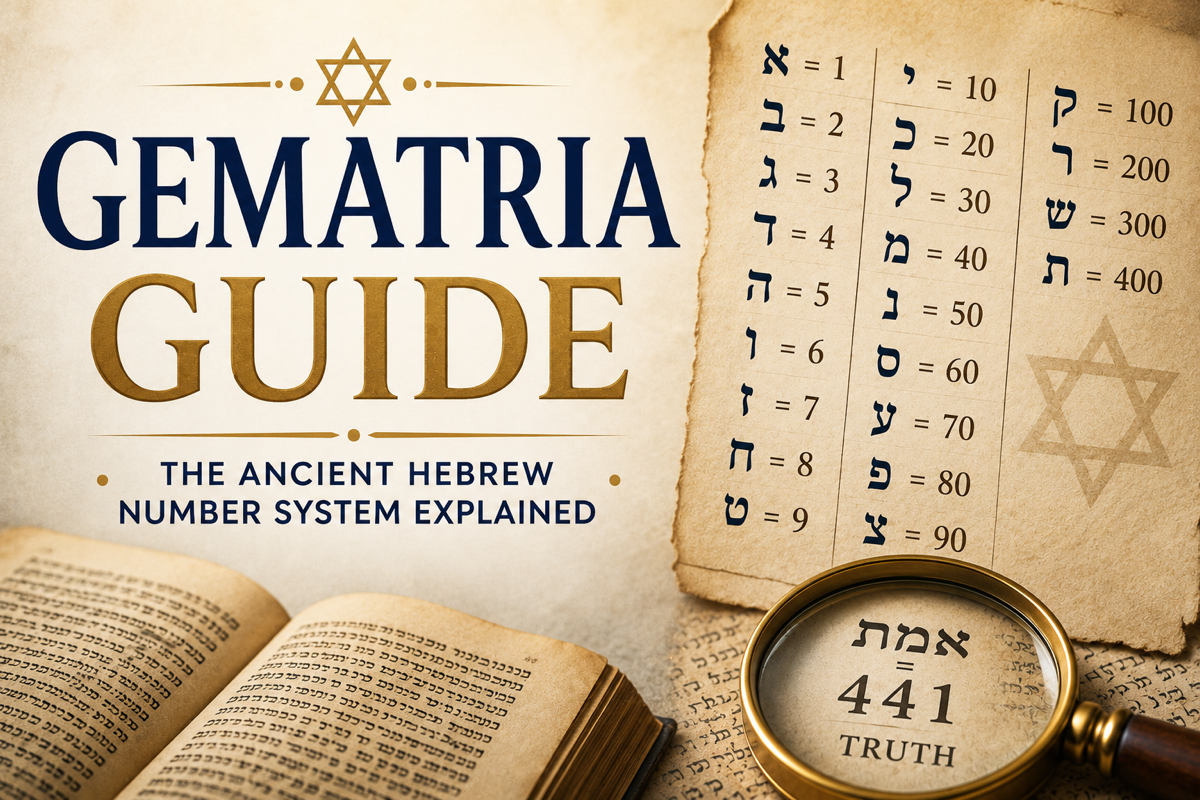
The standard system — called Mispar Hechrachi ("absolute value") — assigns each letter its plain numeric value: 1–9 for the first nine letters, 10–90 (in tens) for the next nine, and 100–400 (in hundreds) for the last four.
| Value | Letter | Name |
|---|---|---|
| 1 | א | Alef |
| 2 | ב | Bet |
| 3 | ג | Gimel |
| 4 | ד | Dalet |
| 5 | ה | He |
| 6 | ו | Vav |
| 7 | ז | Zayin |
| 8 | ח | Het |
| 9 | ט | Tet |
| 10 | י | Yod |
| 20 | כ | Kaf |
| 30 | ל | Lamed |
| 40 | מ | Mem |
| 50 | נ | Nun |
| 60 | ס | Samekh |
| 70 | ע | Ayin |
| 80 | פ | Pe |
| 90 | צ | Tsadi |
| 100 | ק | Qof |
| 200 | ר | Resh |
| 300 | ש | Shin |
| 400 | ת | Tav |
Notice the gap: there's no letter worth 500, 600, 700, 800, or 900 in the basic table. To go higher than 400, Hebrew either combines letters (e.g. 500 = ת+ק, 400+100) or uses the five final letters — which brings us to the next rule.
Final Letters (Sofit) and Their Special Values
Five Hebrew letters change shape when they fall at the end of a word: כ, מ, נ, פ, and צ become ך, ם, ן, ף, and ץ (called the sofit, or "final," forms). In the standard system (Mispar Hechrachi), a final letter keeps the same value as its regular form. But a separate system, Mispar Gadol ("large value"), gives each final letter its own value continuing the sequence from 500 to 900.
| Standard Letter | Final Form | Standard Value | Mispar Gadol Value |
|---|---|---|---|
| כ Kaf | ך | 20 | 500 |
| מ Mem | ם | 40 | 600 |
| נ Nun | ן | 50 | 700 |
| פ Pe | ף | 80 | 800 |
| צ Tsadi | ץ | 90 | 900 |
Unless a source specifies "Mispar Gadol," assume final letters use their standard value — that's the convention behind almost every famous gematria example, including all the ones below.
How to Calculate a Word's Gematria — Step by Step
Calculating gematria is just addition. Take the word שָׁלוֹם (shalom, "peace" / "hello" / "goodbye") as an example:
| Step | Letter | Value |
|---|---|---|
| 1 | ש | 300 |
| 2 | ל | 30 |
| 3 | ו | 6 |
| 4 | ם | 40 |
| Total (gematria of שלום) | 376 | |
- Write the word out letter by letter, ignoring niqqud (vowel marks) — gematria only counts consonant letters.
- Look up each letter's value in the table above.
- Add all the values together.
- The sum is the word's gematria.
That's the entire method. The interesting part is what happens when you do this for many words and start comparing the results.
Famous Gematria Equivalences
Here are some of the best-known gematria values in Jewish tradition — the kind of connections that show up in sermons, books, and (often) jewelry.
| Value | Word | Transliteration | Meaning |
|---|---|---|---|
| 18 | חַי | chai | "alive" / "life" |
| 13 | אַהֲבָה | ahavah | "love" |
| 13 | אֶחָד | echad | "one" |
| 26 | יהוה | YHVH | the divine name |
| 70 | יַיִן | yayin | "wine" |
| 70 | סוֹד | sod | "secret" |
| 358 | מָשִׁיחַ | mashiach | "messiah" |
| 358 | נָחָש | nachash | "serpent" |
| 441 | אֱמֶת | emet | "truth" |
| 611 | תּוֹרָה | torah | "Torah" / "teaching" |
A few of these are worth unpacking:
- חַי (chai) = 18 — this is the most famous gematria of all. It's why monetary gifts in Jewish tradition are often given in multiples of 18 ($18, $36, $180...), as a symbolic blessing for "life."
- אַהֲבָה (love) = אֶחָד (one) = 13 — and 13 + 13 = 26, the gematria of יהוה, the four-letter name of God. A popular teaching reads this as: two (love + one) become unified into the divine name — love is what makes "two" into "one."
- יַיִן (wine) = סוֹד (secret) = 70 — the basis of the well-known saying "nichnas yayin, yatza sod" ("wine enters, secrets exit") — both words share the same numeric value.
- מָשִׁיחַ (messiah) = נָחָש (serpent) = 358 — a frequently cited Kabbalistic teaching, often explained as the messiah's role being to "rectify" or overcome the force represented by the serpent.
- תּוֹרָה (Torah) = 611 — add 2 for the first two of the Ten Commandments (traditionally said to have been heard directly from God, rather than through Moses), and you get 613 — the traditional count of mitzvot (commandments) in the Torah.
- אֱמֶת (truth) = 441 — the example used in the image above. אֱמֶת is built from the first, middle, and last letters of the Hebrew alphabet (א, מ, ת) — fittingly, since truth is said to encompass everything "from beginning to end."
A Beautiful Example: Father + Mother = Child
One of the most shared gematria examples online is also one of the simplest — and it works out perfectly using nothing but the table above.
| Word | Hebrew | Letters & Values | Total |
|---|---|---|---|
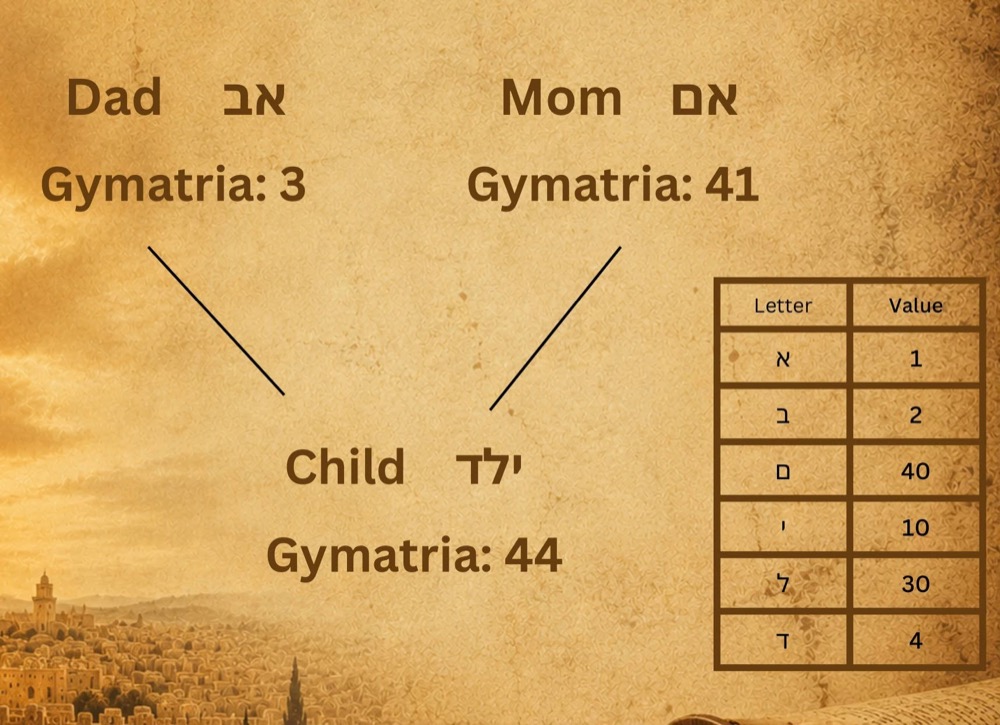
| Av ("Dad") | אָב | א(1) + ב(2) | 3 |
| Em ("Mom") | אֵם | א(1) + מ(40) | 41 |
| Yeled ("Child") | יֶלֶד | י(10) + ל(30) + ד(4) | 44 |
Add the first two totals together: 3 + 41 = 44 — exactly the gematria of יֶלֶד (child). In other words, אָב (father) + אֵם (mother) = יֶלֶד (child), numerically as well as biologically — a relationship that's been sitting inside the Hebrew alphabet for roughly 3,000 years.
The Other Gematria Systems
"Gematria" isn't a single method — it's a family of related counting systems. Mispar Hechrachi (the standard table above) is by far the most common, but you'll occasionally see these others referenced:
| System | Hebrew Name | How It Works | Example |
|---|---|---|---|
| Absolute Value | מספר הכרחי | Each letter keeps its plain value (1–400), as in the main table. | שלום = 376 |
| Large/Full Value | מספר גדול | Final letters (ך ם ן ף ץ) get extended values of 500–900 instead of their regular value. | final ם = 600 instead of 40 |
| Reduced Value | מספר קטן | Drop the trailing zeros from each letter's value before adding (so 400 → 4, 100 → 1, 90 → 9, etc.). | אמת: 1 + 4 + 4 = 9 |
| Ordinal Value | מספר סידורי | Each letter is worth its position in the alphabet (1–22), regardless of its "real" value. | שלום: 21 + 12 + 6 + 13 = 52 |
| Inclusive Value | מספר כולל | Add 1 to the standard total, to account for the word itself. | חי: 18 + 1 = 19 |
If you ever see two words described as having "the same gematria" but the numbers don't match what you calculated with the standard table, the author is probably using one of these alternative systems — it's always worth checking which one.
Try It Yourself — Calculate Your Own Name
The fastest way to make this stick is to calculate a name or word you care about. Let's try דָּוִד (David):
| Letter | Value |
|---|---|
| ד | 4 |
| ו | 6 |
| ד | 4 |
| Total | 14 |
Now try your own Hebrew name (or any word from your lessons): write out each letter, look up its value in the table near the top of this guide, and add. Once you have a number, see if you recognize it from the famous examples above — or just enjoy noticing which other Hebrew words share your total.
Why Gematria Still Matters Today
Beyond its role in classical interpretation, gematria shows up constantly in everyday Hebrew and Jewish life:
- Gift-giving: Cash gifts at weddings, bar/bat mitzvahs, and other celebrations are commonly given in multiples of 18 (chai) — $18, $36, $54, $180 — as a blessing for life.
- Dates and years: The Hebrew calendar writes years as letter-combinations rather than digits. The year 5786, for instance, is written תשפ״ו. Page numbers in many Hebrew books and the numbering of Psalms or chapters can also appear as letters.
- Names and naming: Some families choose baby names partly based on gematria connections to relatives' names or to meaningful words.
- Wordplay and teaching: Rabbis and teachers use gematria as a memorable, almost poetic way to connect ideas — a teaching tool as much as a calculation.
You don't need to believe gematria carries mystical weight to get value from learning it. At minimum, it's a fun way to engage more deeply with Hebrew vocabulary — and once you start noticing that חי = 18, or that אמת spans the alphabet from א to ת, you'll never read a Hebrew word quite the same way again.