
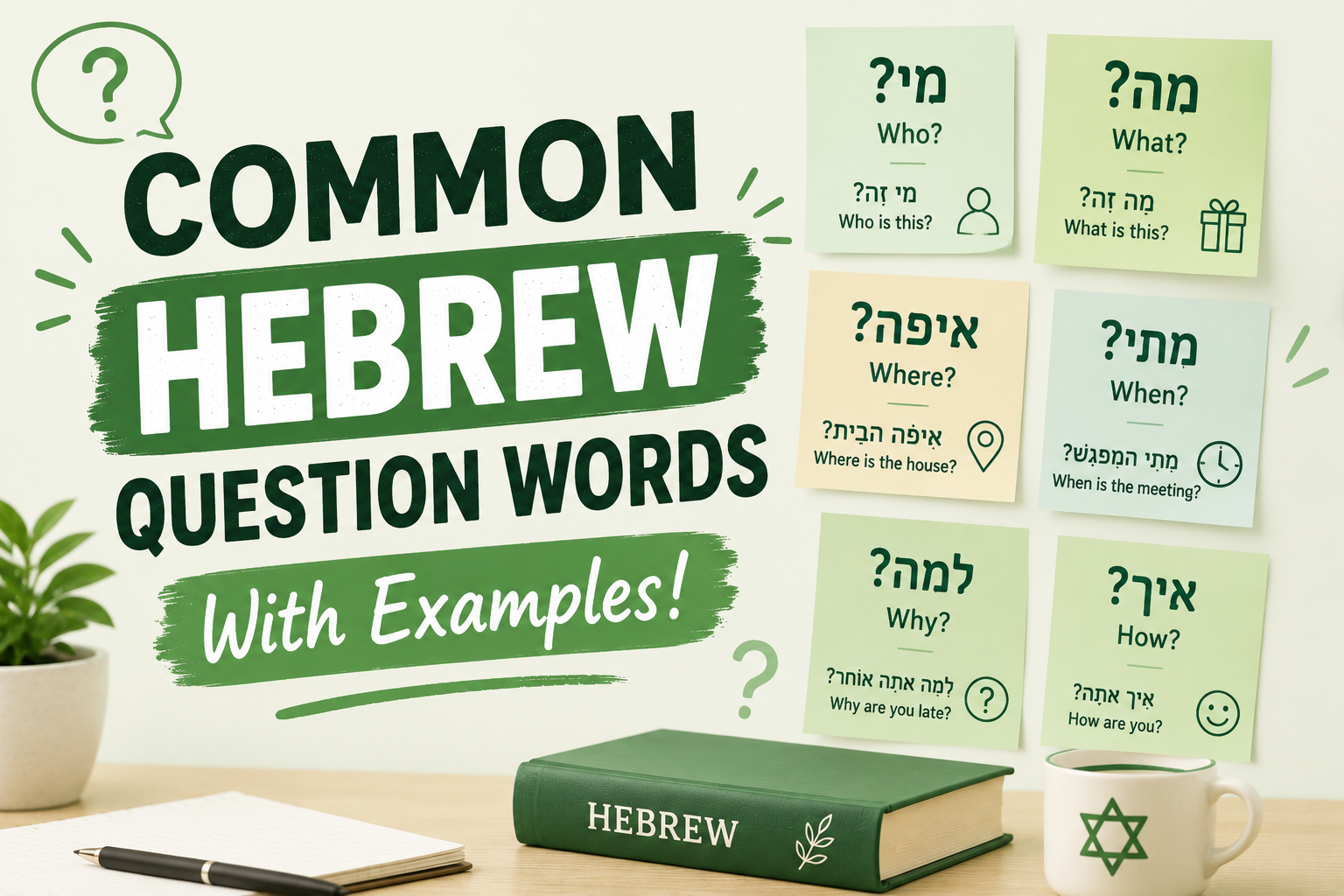
Learning how to ask questions is one of the fastest ways to become comfortable in any language, and Hebrew is no exception. Whether you're traveling in Israel, studying Biblical or Modern Hebrew, or simply expanding your language skills, mastering Hebrew question words will help you hold meaningful conversations from day one.
Hebrew question words are used to gather information, clarify details, and keep conversations flowing naturally. While some question words have direct English equivalents, others have unique nuances that are worth understanding. In this guide, we'll explore the most common Hebrew question words, explain when to use them, and provide practical examples to help you remember them.
Why Learn Hebrew Question Words?
Question words are the foundation of communication. Once you know how to ask questions, you can:
- Introduce yourself and meet new people
- Ask for directions
- Order food and shop confidently
- Learn new vocabulary through conversation
- Understand spoken Hebrew more easily
The good news is that Hebrew question words are relatively straightforward, and many remain unchanged regardless of gender or number.
1. מי (Mi) — Who?
Meaning: Who
Use מי (mi) when asking about a person or people.
2. מה (Ma) — What?
Meaning: What
This is one of the most frequently used Hebrew question words.
3. איפה (Eifo) — Where?
Meaning: Where
Use איפה when asking about locations.
4. מתי (Matai) — When?
Meaning: When
Use מתי to ask about time or dates.
5. למה (Lama) — Why?
Meaning: Why
This question word asks for reasons or explanations.
6. איך (Eich) — How?
Meaning: How
Use איך to ask about methods, conditions, or feelings.
7. איזה (Eize) — Which?
Meaning: Which / What kind of
This word changes according to gender and number:
- איזה (eize) — masculine singular
- איזו (eizo) — feminine singular
- אילו (eilu) — plural
8. כמה (Kama) — How Much / How Many?
Meaning: How much? / How many?
Use כמה for quantities, prices, distances, and age.
9. מאיפה (Me'eifo) — From Where?
Meaning: Where from?
This combines the preposition "from" with "where."
10. לאן (Le'an) — To Where?
Meaning: Where to?
Use לאן when asking about destinations.
11. מדוע (Madua) — Why? (Formal)
Meaning: Why
While למה (lama) is common in everyday speech, מדוע (madua) is more formal and often appears in books, newspapers, speeches, and official writing.
Tips for Using Hebrew Question Words
1. Pay Attention to Gender
Hebrew often distinguishes between masculine and feminine forms in verbs and pronouns. The question word stays the same, but the rest of the sentence changes:
- מָה אַתָּה עוֹשֶׂה? — What are you doing? (male)
- מָה אַתְּ עוֹשָׂה? — What are you doing? (female)
2. Learn Common Expressions
Some Hebrew questions are fixed expressions that don't translate word-for-word into English:
- אֵיךְ קוֹרְאִים לְךָ? — What's your name? (lit. "How are you called?")
- בֶּן כַּמָּה אַתָּה? — How old are you? (lit. "Son of how much are you?")
- מָה נִשְׁמַע? — How's it going? (lit. "What is heard?")
3. Practice Listening
Watch Hebrew TV shows, YouTube videos, or podcasts and pay attention to how native speakers ask questions. You'll quickly notice that words like מה, מי, איך, and למה appear constantly in everyday conversation.
4. Answer Your Own Questions
Practice by creating simple question-and-answer pairs:
This method reinforces both vocabulary and sentence structure.
Quick Reference Table
| Hebrew | Transliteration | Meaning |
|---|---|---|
| מִי | Mi | Who |
| מָה | Ma | What |
| אֵיפֹה | Eifo | Where |
| מָתַי | Matai | When |
| לָמָּה | Lama | Why |
| מַדּוּעַ | Madua | Why (formal) |
| אֵיךְ | Eich | How |
| אֵיזֶה | Eize | Which |
| כַּמָּה | Kama | How much / How many |
| מֵאֵיפֹה | Me'eifo | From where |
| לְאָן | Le'an | To where |
Final Thoughts
Hebrew question words are essential building blocks for communication. By mastering words like מִי (who), מָה (what), אֵיפֹה (where), מָתַי (when), לָמָּה (why), אֵיךְ (how), אֵיזֶה (which), כַּמָּה (how much/how many), מֵאֵיפֹה (from where), and לְאָן (to where), you'll be able to ask for information, understand conversations more easily, and participate confidently in everyday Hebrew.
The best way to remember these question words is through regular practice. Try using them in short conversations, flashcards, or language exchange sessions. Over time, asking questions in Hebrew will become second nature, making your language-learning journey both more enjoyable and more effective.